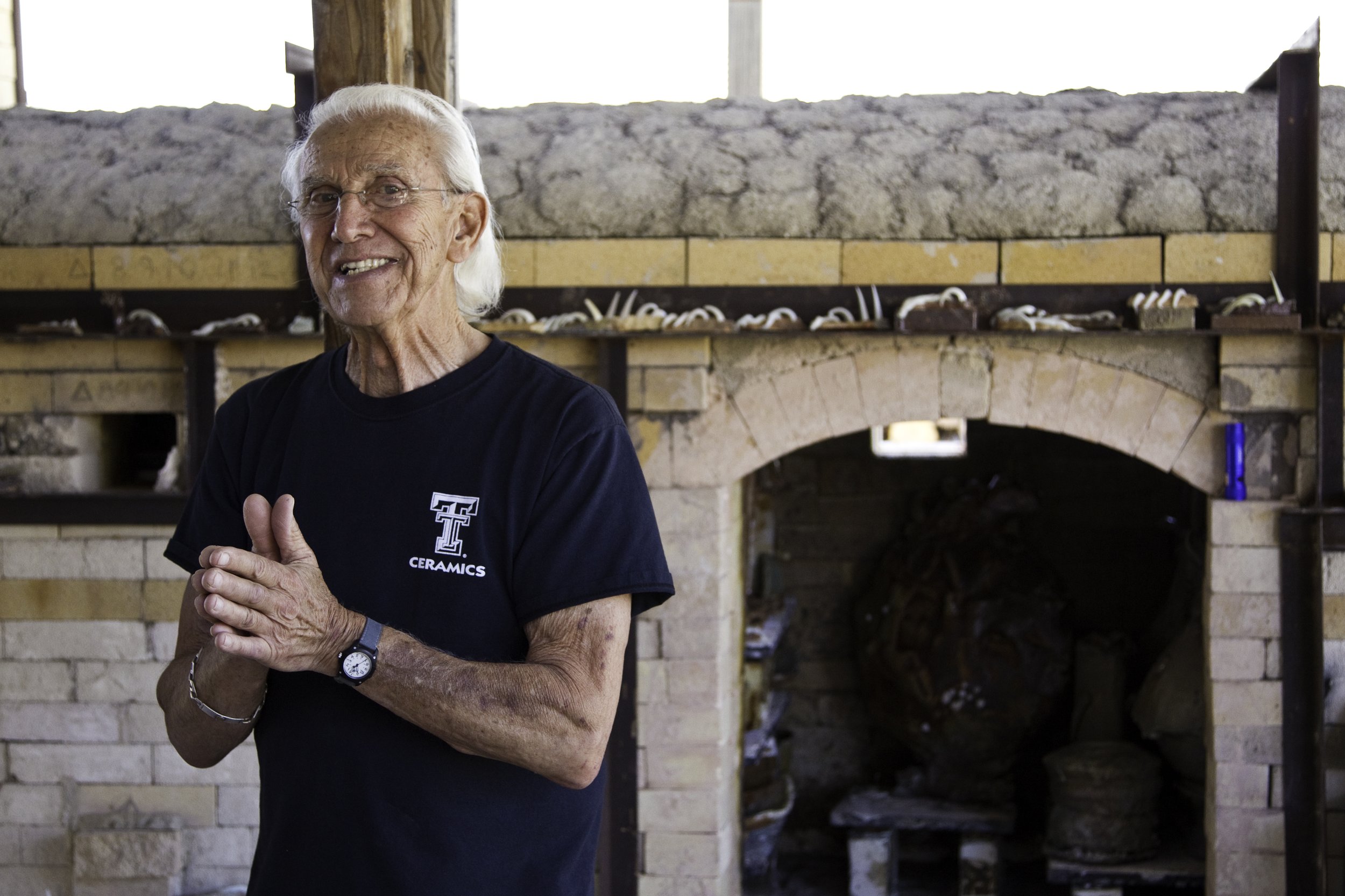
Before lighting a wood kiln, there is a moment of stillness. The stacking is complete, the firebox waits, and the outcome is unknown. At the Reitz Ranch in Sycamore Canyon, that moment was often marked by a familiar phrase spoken before the flame was lit:
“Give us problems, so we may learn.”
That sentiment anchors Kindled: The Reitz Studio Legacy, an exhibition on view at the Sedona Arts Center’s Special Exhibition Gallery from December 12, 2025, through January 23, 2026. Featuring work by Don Reitz alongside that of his former studio assistants, the exhibition reflects on shared labor, long firings, and the ways uncertainty shaped both material and mentorship.
For Reitz, this phrase was not rhetoric. It was a way of working, teaching, and living.
The Studio as Kiln
To assist Reitz was to enter a studio that functioned much like a wood kiln itself—demanding, unpredictable, and deeply communal. Days stretched into nights during firings. Conversations unfolded while splitting wood, cleaning shelves, and responding to the kiln in real time.
“I wrote Don a letter in ’98 or ’99 introducing myself and asking if he needed an assistant,” recalls Mat Rude, who worked with Reitz from 1999–2008. “He wanted to see if we were a good fit personality-wise… I was invited to be his assistant. I was over the moon.”
With time, that initial excitement gave way to a deeper understanding of what life at the ranch demanded. “All the weirdness on so many levels,” Rude reflects. “Sometimes it was funny, sometimes it was very frustrating. Navigating it all could be very challenging at times, and it made ranch life feel like a rollercoaster. Never a dull moment. Sometimes I would hope for a dull moment.”
For others, the rhythm of the studio defined daily life. “Every day, I start around sunrise by sweeping and organizing the studio,” recalls Preston Tolbert. “I cleaned and laid out Don’s tools… Don was in his ‘sandbox.’ He got in the zone, and magic flowed. I learned to keep my mouth shut.”
The work required attentiveness not only to clay and fire, but to Reitz himself. Dean Adams, his first studio assistant, describes the complexity of that relationship: “One of the hardest parts about being an artist’s assistant is that there needs to be a very close relationship between artist and assistant—sometimes closer than they are to their spouse or children. I witnessed a lot. Don was a very complicated person.”
Reitz was generous, charismatic, and deeply private. Assistants learned quickly that presence mattered more than instruction.
Learning Through Fire
Failure was not avoided in Reitz’s studio; it was expected. Firings rarely behaved as planned, and disappointment was part of the rhythm.
“Many times when we unloaded a kiln, Don would be in a sort of depression,” recalls Sara Tolbert. “The kiln never did exactly what he expected. But a week or two later, all he could talk about was how good that firing was.”
Tolbert credits Reitz with teaching her patience and trust in process. “If you don’t like it: refire. Still don’t like it? Refire. Still don’t like it? Salt it,” she remembers. “Don made me realize that it’s okay to fire something until it falls apart.”
That lesson—seeing failure as information—echoes throughout the exhibition. Casey McDonough, who assisted Reitz in 2004–2005, reflects, “My confidence grew while my ego was humbled. Looking back on it, the year there was one of the most formative of my adult life.”
The Land and the Long View
The ranch itself was inseparable from the work. Dean Adams recalls waking in his trailer to see the Hale-Bopp comet hovering on the horizon night after night. “It had been my companion,” he says. “When the comet left our visible world, Don and I talked about how amazing it was.”
The land carried history as well. Adams remembers encountering intact nesting bowls along the Verde River—utilitarian ceramic forms attributed to ancestral Indigenous communities of the region—while living and working in the area. “They didn’t belong to me,” he reflects. “They belonged there.”
This sense of stewardship extended beyond objects. Brian Harper, who worked with Reitz from 2001–2002, speaks of the importance of time: “Don always had plans that were years in the making. He dug the trench for the anagama years before any bricks arrived. That taught me to play the long game.”
Passing the Torch
What Reitz passed on was not a style, but an ethic. Heidi Kreitchet, who assisted Reitz from 2004–2006, remembers the advice that still guides her practice: “Don’t let anyone steer your direction. Keep pushing clay. Show up. There is no such thing as a bad firing.”
For Jesse Albrecht, the experience was life-altering. “To share in artmaking with Don is one of the greatest gifts of my life,” he writes. “And to continue making art alongside the people whose strength, stories, and generosity shaped me is something I’m deeply humbled by.”
The Fire Continues
Kindled is not a retrospective. It is a continuation. Like embers held long after a kiln cools, the energy of Reitz’s studio persists in the work and lives of his assistants. They carry forward not answers, but questions—ones shaped by fire, labor, and shared experience.
Before lighting the kiln, the words still echo:
“Give us problems, so we may learn.”
The fire is lit. The torch is passed. And the learning continues.
Exhibition Details
Kindled: The Reitz Studio Legacy
Sedona Arts Center — Special Exhibition Gallery
December 12, 2025 – January 23, 2026
Participating Artists:
Don Reitz, Mat Rude, Dean Adams, Jesse Albrecht, Ben Roti, Preston Tolbert, Sara Tolbert, Heidi Kreitchet, Casey McDonough, Jake Allee, Brian Harper, Larry Meagher, David Lloyd Bradley, Nate Sonnenberg, Karen Hamilton